Showing posts with label Japan. Show all posts
Showing posts with label Japan. Show all posts
Saturday, September 30, 2017
Getting around Kyoto
One difference to life in Japan is that we don't have a car. Sometimes, we use some public transportation (buses, trains, subways), but mostly we walk. This makes everything take longer, but you also notice lots of beautiful things along the way that you would have missed otherwise - like this little guy.
Butterfly = 蝶 (kanji), ちょう(hiragana) - pronounced "chou"


Monday, December 28, 2009
Back to "Japan"
Nihon e ikitai desu. Nihon e ikitai desu. Istu? Ima. Mochiron. Ikimasenka? Ikimashou!
It's been a year since we have set foot in our beloved Japan. And, while we enjoy living stateside now, we do miss LOTS of things about our lives in Kyoto.
Thanks to Pa, this Christmas, we were lucky enough to be able to return to "Japan" for a day.
With grandparents chomping at the bit for an extended babysitting opportunity and two fellow fun-seekers (Charlie and Erin) to share the day with, we headed out on an Asian Adventure in New York City.


It's been a year since we have set foot in our beloved Japan. And, while we enjoy living stateside now, we do miss LOTS of things about our lives in Kyoto.
Thanks to Pa, this Christmas, we were lucky enough to be able to return to "Japan" for a day.
With grandparents chomping at the bit for an extended babysitting opportunity and two fellow fun-seekers (Charlie and Erin) to share the day with, we headed out on an Asian Adventure in New York City.
Our first stop was Katagiri. Chris says that they are the oldest Japanese grocer in New York City. Sugoi desu ne! We stocked up on lots of Japanese favorites that we hadn't been able to find in the US - (real) Udon and soba noodles, Pocky, Sansai (Kyoto mountain vegetables), Tonkatsu sauce, (good) gyoza sauce, and kabocha, a Japanese pumpkin that my Dad said looked like a calabasa. Yum!! They even had a fridge full of C.C. Lemon!
Just in case we didn't have enough authentic groceries in our bags, we hit another Japanese grocer - JAS Mart. This shop was larger, but carried more snacks and non-food items as opposed to fresh foods. I was excited to find so many brands of canned Japanese coffee. Also, they carried the dehumidifying pouches and containers for drawers and closets. Not that I need them in the middle of dry winter, but I got a few anyway for when warmer wetter weather prevails!

Next, on the recommendation of my friend Dan, we went to Ippudo, a New York branch of a popular Japanese ramen chain. Even though we arrived before 5pm, there was still a bit of a wait. This place was SO popular, and rightfully so. Our ramen was **amazing!** Chris and Charlie both got the special and Erin and I both got the Akamaru-modern. Following the traditional custom we all ordered "Kae-dama onegaishimasu!" - a second helping of noodles for our ramen broth. As we were leaving, the lines of hungry diners filled the bar, lobby and poured out onto the street. Clearly, being early was the way to go.


Our final stop was Duet 35 - an authentic Japanese karaoke place near Penn Station. Japanese karaoke is so much cooler than a typical American karaoke bar because instead of putting your name on a long list only to have to then sing in front of a room of strangers, you get your own private room with a big screen TV and microphones for just you and your friends! We met up with a bunch of Charlie's friends there- all of whom were excellent singers. :)


Another fun feature, you can order drinks and snacks to be brought to your room. Chris and I each ordered one Kahlua Milk drink just like we did on most singing occasions with Muraki-mama, Sayaka and Dominikus! Natsukashii desu ne! Plus, the drinks made everyone sing (and hear) better! We stayed for over two hours, until our vocal chords begged us to hop on the next train home.
What a fun and nostalgic day! For the record, not having to take a 15 hour flight to enjoy these Japanese foods and activities is AMAZING! Anyone up for a repeat adventure?


Another fun feature, you can order drinks and snacks to be brought to your room. Chris and I each ordered one Kahlua Milk drink just like we did on most singing occasions with Muraki-mama, Sayaka and Dominikus! Natsukashii desu ne! Plus, the drinks made everyone sing (and hear) better! We stayed for over two hours, until our vocal chords begged us to hop on the next train home.
What a fun and nostalgic day! For the record, not having to take a 15 hour flight to enjoy these Japanese foods and activities is AMAZING! Anyone up for a repeat adventure?
Sunday, November 30, 2008
Japan Movie
Renee made a video montage of our time in Japan over the summer, and we've been meaning to post it for a while now. Here it is (roughly 10 minutes...):
Tuesday, August 5, 2008
Shake, Rattle and Roll
With two hours to spare before the Kansai Airport bound MK Shuttle came to pick us up, we squeezed in one last quintessentially Japanese experience -- an earthquake.
Since we were excited/nervous about our trip back to the US, we were both inadvertently awake ahead of the alarm clock which was scheduled to ring at 6:30am. This was good since the earthquake struck at 6:26am. If we weren't awake, we probably would have missed it.
Other than being an earthquake, it was not noteworthy and thankfully only measured a 3.8 on the Richter scale. In fact, at first, Chris was convinced that the rumbling was caused by a truck driving by. Because of the simulations during my field trip to the disaster center I was pretty sure it was an earthquake. We stood in a door frame and in about 10 seconds, the whole thing was over. In the end, all that happened was that one more thing got checked off our "things to experience in Japan" list. Talk about down to the wire... almost missed this one. Whew! :)
The online news article from the Mainichi Daily News was taken down quickly in favor of more recent news, but here is the text, if you'd like to read it.
Since we were excited/nervous about our trip back to the US, we were both inadvertently awake ahead of the alarm clock which was scheduled to ring at 6:30am. This was good since the earthquake struck at 6:26am. If we weren't awake, we probably would have missed it.
Other than being an earthquake, it was not noteworthy and thankfully only measured a 3.8 on the Richter scale. In fact, at first, Chris was convinced that the rumbling was caused by a truck driving by. Because of the simulations during my field trip to the disaster center I was pretty sure it was an earthquake. We stood in a door frame and in about 10 seconds, the whole thing was over. In the end, all that happened was that one more thing got checked off our "things to experience in Japan" list. Talk about down to the wire... almost missed this one. Whew! :)
The online news article from the Mainichi Daily News was taken down quickly in favor of more recent news, but here is the text, if you'd like to read it.
A moderate earthquake jolted Osaka, Kyoto and Hyogo Prefectures early Wednesday morning, the Meteorological Agency said. There was no report of casualties or damage to property. No tsunami warning was issued following the quake.
The temblor that struck at 6:26 a.m. registered 3 on the 7-point Japanese intensity scale in Takatsuki, Osaka Prefecture, and Kameoka, Kyoto Prefecture. It also measured 2 on the Japanese scale in extensive areas of Osaka, Kyoto and Hyogo prefectures. The focus of the earthquake, which is estimated at 3.8 on the open-ended Richter scale, was located about 20 kilometers below the ground in southeastern Hyogo Prefecture.
Awesome Itinerary
 Tomorrow is the big day! We are leaving Japan and returning to the United States. I still can't believe it.
We're really sad about leaving Japan, but we have a lot to look forward to as well. For example, it's so much easier to visit friends and family by taking a drive or hopping on a train than it is to fly across continents and oceans. And, it is much easier to call people who live in nearby timezones. So, that's exciting. :)
Chris's ticket was purchased by the Japanese government. They attempted to get him as short and direct a flight as possible. So, his itinerary is simply: KIX - DET - PIT. He will leave Osaka on Wednesday and arrive in Pittsburgh later that same day.
I've already unveiled my exciting return itinerary to several of you, but I'm still so tickled by its sheer awesomeness, that I must share it further. Since my ticket purchase was coming straight from our wallets, I aimed to get the cheapest and most fun alternative available, and I think I succeeded. I will be taking the following route: KIX - PEK - LAX - Costa Mesa - San Diego - SAN - SFO - PIT.
I will get to spend five hours in the Beijing Airport, which is exciting because it will be only two days before the Olympics begins. I hope I get to see some athletes while I am there. But, the absolute best part is that I will get the chance to see and stay with friends of mine in Costa Mesa and San Diego while still paying less for the trip. I'm lucky to know such cool folks in such convenient locations. :) Can't wait to get my travel on!
(Update: I did see some Olympic athletes in Beijing. Sweet! Also, I missed my connecting flight in SFO and had the opportunity to wait nine additional hours before catching a red-eye flight to Pittsburgh. This little switch resulted in my leaving Osaka on Wednesday morning, but not arriving into Pittsburgh until Saturday morning. How awesome is that?!)
Monday, July 28, 2008
Firewalking, Kyoto Style

 Tonight was the Hiwatari Matsuri at Tanukidani Fudo temple in the northeast mountains of Kyoto. (For those that care, this event is also sometimes referred to as Sennichi Mairi Hiwatari-sai.) It was a really fun festival - one that we had been looking forward to for months. The basic idea was that everyone walks across ash and hot coals while praying for protection from illness and misfortunes. A chance to walk on hot coals! Who could possibly pass that up?
The festival was officiated by a group of yamabushi, or mountain monks.
 They chanted several sutras and said prayers while lighting a huge bonfire of wooden planks arranged in a square and covered with cypress leaves. They also had one priest wave a haraigushi (wand with zigzag strips of white paper) over the area to purify it. Even though the evening was rainy, the bonfire still sprang to life almost instantly upon being lit. While the fire roared, stacks of gomagi (wooden sticks with prayers written on them) were thrown into the fire. The yamabushi, together with Buddhist pilgrims in white robes, continued to recite prayers over the burning flames. Adding to the other-worldly atmosphere, were the sounds of monks blowing on conch shells and drumming.
 When the fire calmed down somewhat and the wooden planks started to collapse, the monks broke down the bonfire with rakes. Then, the ash, coals and remaining wood pieces were spread and raked to form a path. I'd guess the path was about 10 meters long. Most of the red coals and embers were pushed to the sides of the path. So, it wasn't really that long or that hot.
Finally, it was time to begin the firewalking. The monks and pilgrims walked across first, cutting the ropes at both the beginning and end of the path. Behind the monks, a long line of eager participants followed. We placed ourselves near the back of the line hoping to get an idea of what to expect before we were called on to take part. Before setting out across the embers, each barefoot participant was given a red paper amulet and blessed. Upon successfully walking over the coals, each person was blessed again.
We were surprised to find that the coals did not feel hot on our feet. Most days, the sand at any given beach is hotter! At the outset, I was almost giddy with anticipation and had set up some pretty high expectations. I'm happy to report that the experience did not disappoint. I challenge you to go firewalking, Kyoto style. You'll be purified and protected... and you'll like it.
Tuesday, July 22, 2008
Happy Japanniversary!
 As of today, we have been in Japan for one year. It is amazing how fast the time has gone and how many experiences we were able to squeeze into those twelve months. While it is fun to reflect on all the blessings and adventures of the past year, it's also foremost in our minds that we will be leaving Kyoto in two short weeks.
Twelve and a half months was not long enough for us to experience everything that Japan has to offer. I guess we'll just have to come back someday. :)
Here is an abridged list of things I will REALLY miss:
- Japanese festivals
- My students (こんにちは ひふみーさん,のりこーさん,みほーさんとみほーさん.)
- My landlords
- My friends in Japan (Special shout out to Sandra and Rieko)
- The friends I made in Japan who are also no longer in Japan
- Ikebana-sensei and ikebana class
- Tea Ceremony class (Mochi and Matcha)
- Walking/Biking all over Kyoto
- Relaxing by the Kamo-gawa River/Uji-gawa River
- Daimonji-yama
- Incredibly fresh and cheap sushi
- ごま ice cream
- Fireworks
- Wearing yukata
- Cherry Blossom season
- Special regional foods and sweets (ie: Okonomiyaki from Hiroshima, Momiji manjuu from Miyajima, Tonkatsu ramen from Hakata/Fukuoka, Takoyaki from Osaka, Sudachi mochi from Tokushima, etc...)
- Good (STRONG) coffee
- Onsens
- Karaoke
- Infinite photographic inspiration (See example above from Katsura Imperial Villa)
Sunday, July 13, 2008
Maiko-san! Maiko-san!
 Today was a great day. I discovered that I REALLY like feeling like a princess (or in this case a Maiko-san). It's the kind of fun that makes your eyes sparkle and lets your glee radiate out in all directions.
I went to Studio Shiki, a maiko transformation photography studio. The transformation from Gaijin to Maiko (Kyoto Geisha in training) was fascinating, and the preparations only took about 40 minutes which was a big surprise considering how different the "Before" and "After" were.
The process began by changing into a pair of tabi (two toed white socks) and a thin linen kimono undergarment which tied through the left underarm and around the waist. Once changed, I was hurried off to the makeup room. A very talented makeup artist got started by concealing my hair in a net and covering the netting with a cloth.
 Then, she sprayed her "canvas" with something that I think was stage makeup wax. She began to coat my face, chest and back with a thin layer of Oshiroi, white makeup. Using brushes and sponges, she made sure everything was completely snow white. Then, she drew the trademark sensual design at the nape of my neck. It tickled. I liked it.
After the Oshiroi was done, the makeup artist added blush highlights of pinks and reds around my eyes and on my cheekbones. She continued by applying more pink blush, red eyeliner, liquid black eyeliner, and mascara to my eyes, and red and black eyeliner to my eyebrows.
The last step in the makeup transformation was painting on the deep red lips. The crimson was very wet at first and I had to hold still for the lip color to set. When the color was dry, we discovered that some of my teeth were also coated in crimson. When I asked what to do... she said たべてくだしさい or eat it, please. It didn't actually taste that bad, but I do wonder about the nutritional merits of lipstick.

When the makeup was finished, I was given the near impossible task of choosing a kimono. There were dozens upon dozens upon dozens of beautiful silk kimonos in every color with all sorts of designs and flowers. I wanted the prettiest one, so it took me a while to decide.
Finally, I was ready to get dressed. Two women helped me put on additional kimono undergarments and then the kimono itself. Once the kimono was on, it was easy to see that it was a furisode kimono - the kind with the really long sleeves. Sugoi! After the kimono was in place, my dressers moved on to the obi (kimono sash or belt). For maiko, the obi is tied in a different way, allowing it to dangle. There
 were also at least two separate sections to attach in addition to the outer decorative cords. As far as I can tell, this only makes it feel a lot heavier.
When the obi was tied to perfection, it was time to put on a katsura or maiko style wig. The katsura had several benefits: being the proper color, taking only about five minutes to put on as compared to the two hours it typically would take to create the same style in a salon, and it was already adorned with all the appropriate kanzashi
 (hair ornaments). I think the ones in my wig were primarily red and white plum blossoms (usually worn in February, but very popular) and an Ogi kanzashi or metal, fan shaped ornament with aluminum streamers.
The last step before heading out was putting on the okobo, or the particularly precarious wooden (usually willow) sandals worn by maiko. These sandals are also called pokkuri or koppori because of
 the sound they make when you walk. Because of the way the wood is carved, it felt a little bit like walking on two small rocking horses. Very interesting! I was happy to find that while they were a little tricky to get used to, they weren't as uncomfortable as you might guess.
The breathtaking (!) transformation complete, it was time to begin the "on-location photo shoot" in one of my favorite areas of Kyoto. We wended our way through the small stone streets and alleys of Ninen-zaka, Sannen-zaka and Nene no michi (near Kodaiji Temple and the Ryozan Kannon) with very typically Kyoto backgrounds of traditional Japanese-style houses, walkways and the palpable ambience of the streets all around us. The photographer was really friendly. I had a great time with her.

While the photo shoot was going on, tourists and locals alike were pausing to squeal "Maiko-san! Maiko-san!" and take a few pictures on their cell phones and cameras. It made me feel like a princess and a rock star all at the same time. I could definitely get used to this! :)
After the professional photographer was done, we were able to walk around the Kiyomizudera/Higashiyama area on our own for about half an hour taking our own pictures and luxuriating in the few moments of celebrity and the total confidence which comes with it.
The maiko transformation was unspeakably fun and now I have loads of great pictures which I know I will love for years to come. If, for some reason, you actually want to see more, I promise I won't be shy about sharing. For anyone planning to visit Kyoto, I unequivocally recommend this photo studio and this experience for you or any girls joining you on your travels. Honto ni, tanoshikatta desu ne!


Monday, July 7, 2008
Tanabata Matsuri
 I haven't told you about many festivals lately, so I thought I'd let you know about today's fun festival... Tanabata. It is a star festival derived from an old Chinese holiday called Qi Xi.
This festival is one part astronomy, two parts love story.
Part 1:
In the night sky, there are two constellations that only meet once a year, on July 7th. These constellations are Vega (Orihime - a weaver princess) and Altair (Hikoboshi - a cow herder).
Parts 2 & 3:
Orihime and Hikoboshi were both young workaholics. She weaved beautiful cloth all day and he tended to his cattle all the time. One day, these two met and fell instantly in love. Thus, they spent all of their time together and neglected their jobs - no new cloth was woven and the cattle all became sick. This angered her father, so he separated them. Then, they were so sad, they couldn't work anyway. So, Orihime's father decided to allow them to meet once a year. That way, the work could be done and they could see each other again. (Wow, what a deal!)

To help us learn about the celebration, my Japanese class threw a Tanabata party on Friday.
We learned that the way that this festival is celebrated is more fun than the story. Typically, you write wishes on colorful paper strips (tanzaku) and hang those wishes on a Tanabata bamboo tree. Other colorful decorations are also put on the tree. For example, people often hang origami cranes symbolizing long life, nets symbolizing fishing, good harvests and the Milky Way, and long streamers symbolizing the threads that Orihime used to weave.
Later, the tree and all the decorations can be burned or floated down a river so that the wishes all come true. Although, I'm pretty sure that the Tanabata tree that we decorated in my Japanese class will just be dismantled and put away. No fire for us. :(

I made a delicious cheesecake decorated with strawberries and blueberries since the date of our party was also the 4th of July. I figured it would be fun to learn about Tanabata while teaching my classmates and senseis the words to Yankee Doodle and America the Beautiful. They were both received well, but I'm pretty sure the cheesecake was a bigger hit. Then, the senseis taught us all a traditional Tanabata song.
ささのは サラサラ のきばにゆれる (Bamboo leaves are rustling under the eaves)
おほしさま キラキラ きんぎんすなご (Stars are twinkling like gold and silver sand in the sky.)
ごしきのたんざくわたしがかいた (Some pieces of fancy paper on which we wrote out wishes.)
おほしさま キラキラ そらからみてる(Stars are twinkling and looking at the scene on the earth.)
You can try to sing along with my senseis. They are doing the 3rd and 4th lines here. Good Luck!
Wednesday, July 2, 2008
Let's Science Dialogue!
Today, I really had a once-in-a-lifetime experience. The Japanese government has a program ("Science Dialogue") for promoting scientific careers for young students. Foreign researchers are invited to give lectures in English on their research fields at Japanese high schools. I was invited to participate earlier this spring, and today was the day!
My talk was at the Akashi College of Technology, which is a school for students aged 16-20. Roughly speaking, it combines three years of high school with two years of college. My audience was a class of about forty 16-year-old students. (Incidentally, the textbook for their class was fantastic. It weighed about half a pound and cost about $15. Now think about your freshman algebra or calculus textbook, and compare...)
Giving the lecture was a lot of fun, but it was also quite difficult. First of all, I gave a presentation (see the slides) instead of using the chalkboard, which was a first for me. Using slides was necessary so that I could add Japanese translations for the terms in my talk. Second, it was important for me to speak slowly, so that the students could follow my English. My normal lecture style is very quick, and I like to walk back and forth as I talk. Now, I suddenly had to stay in one place and deliberately speak very slowly. This was pretty disorienting for me.
My research collaborator also came, and acted as a translator during parts of the talk. (He also helped me in translating my slides.) After the talk, I took questions from the students. This involved a lot of giggling, because the students were required to ask their questions in English, and this appeared to make them nervous. One girl in the audience impressed everyone by spotting an error on one of my slides... (I had written 41616 = 194^2 instead of 204^2. The slide appeared on-screen for perhaps a minute at most -- how she spotted the error is beyond me!)
Most of the questions were rather off topic, but still fun to answer. One student wanted to know what Japanese food I liked, another wanted my opinion of their textbook. A third student asked how long I had been married!
Here is a picture we took afterwards. I am sitting between Renee and my collaborator. On the other side of Renee is Matsumiya-sensei, the class's teacher. (We're all holding up three fingers in celebration of triangular numbers, which figured prominently in my talk.) You can get more pictures of the event from this link. In a couple of months, I'll get a report of student evaluations. I hope they liked the talk!
My talk was at the Akashi College of Technology, which is a school for students aged 16-20. Roughly speaking, it combines three years of high school with two years of college. My audience was a class of about forty 16-year-old students. (Incidentally, the textbook for their class was fantastic. It weighed about half a pound and cost about $15. Now think about your freshman algebra or calculus textbook, and compare...)
Giving the lecture was a lot of fun, but it was also quite difficult. First of all, I gave a presentation (see the slides) instead of using the chalkboard, which was a first for me. Using slides was necessary so that I could add Japanese translations for the terms in my talk. Second, it was important for me to speak slowly, so that the students could follow my English. My normal lecture style is very quick, and I like to walk back and forth as I talk. Now, I suddenly had to stay in one place and deliberately speak very slowly. This was pretty disorienting for me.
My research collaborator also came, and acted as a translator during parts of the talk. (He also helped me in translating my slides.) After the talk, I took questions from the students. This involved a lot of giggling, because the students were required to ask their questions in English, and this appeared to make them nervous. One girl in the audience impressed everyone by spotting an error on one of my slides... (I had written 41616 = 194^2 instead of 204^2. The slide appeared on-screen for perhaps a minute at most -- how she spotted the error is beyond me!)
Most of the questions were rather off topic, but still fun to answer. One student wanted to know what Japanese food I liked, another wanted my opinion of their textbook. A third student asked how long I had been married!
Here is a picture we took afterwards. I am sitting between Renee and my collaborator. On the other side of Renee is Matsumiya-sensei, the class's teacher. (We're all holding up three fingers in celebration of triangular numbers, which figured prominently in my talk.)
 You can get more pictures of the event from this link. In a couple of months, I'll get a report of student evaluations. I hope they liked the talk!
Wednesday, May 14, 2008
My weekend in Shikoku
This weekend, I took a trip to Kagawa Prefecture to participate in a seminar in Takamatsu. Takamatsu is one of the northern-most towns on Shikoku, Japan's smallest of the four main islands. I met up with Hiraoki, another speaker for the seminar in Okayama, and we took a train across the Great Seto Bridge (Wikipedia). This is actually a chain of bridges across several small islands, but the whole construct is about 13 kilometers long! Unfortunately, it was already after dark as we went over it, but I got a better view on the return trip on Sunday.
Saturday morning, Hiraoki and I went on an Udon tour. You see, Shikoku is considered to be especially famous for its udon cooking. Udon is a Japanese noodle dish, usually served in a broth with some extra dish on top, like a cooked egg, vegetables, or fish. You can get it anywhere in Japan, but Shikoku is filled with small udon restaurants, each owned by one family with their own personal recipe for both the udon itself, and how they serve it.
So at about 10 a.m., we headed out. When you get to a restaurant, you pay in advance (maybe 200-400 yen, typically) for a bowl of udon. There are large bins of boiling water with metal colanders hanging in them. You transfer your noodles to the colander and stir it for a few moments in the water to reheat the noodles. Then you drain them back into your bowl and move on to a large vat of broth to add to your noodles. Finally, you add whatever extra you might have paid for (like tempura kabocha, in my case). You grab a seat at a bar and dig in!
Udon is just a thick white noodle, so I was a little skeptical that it would taste different in various restaurants, but that is definitely the case. I had one mediocre batch (too salty) and one fantastic batch (but see below). We had to get back to the University for our talks in the afternoon, so we didn't go all out. But we finished up with some Hiroshima-style okinomiyaki before catching a taxi.
My talk went fine (a 90 minute presentation -- a first for me), and there was a colloquium dinner afterwards. We went to a sushi restaurant and some of the faculty recommended that I check out the shrines atop Zozu mountain before leaving Shikoku. This was great advice!
There are two shrines on the mountain, Kotohira-gu and Izutama (the inner shrine). The colloquial name is Konpira, and this is considered one of the 88 shrines of the pilgrimage inside Japan. The trek up takes 1368 steps, and it is considered traditional to count the steps on the way up (Folk Stories). I miscounted both on the way up and on the way back down, but in my defense I was trying to do it in
Japanese.
Kotohira-gu is the more impressive shrine, and it takes `only' 700 steps to get there. There are several exhibits on display: a pair of horses, the propeller of a Japanese war-ship, a scientific boat that was blessed at the shrine, traditional Japanese drums, and -- for some reason -- a set of fun house mirrors. Check my Facebook photos for more details.
 But of course, you can't go that far and not finish. So I trekked on to Izutama. Really, the shrine at the very top is very humble in comparison. But there is a magnificent view of the Sanuki plains from the top. After a very long hike back down, I bought a few souvenirs and was heading back to the train station. But a little old lady in front of an udon shop came up and invited me into her restaurant. Too tired to consider my other options, I followed her in and ordered a Sanuki-Udon. It was amazing -- far better than the udon on Saturday. I chatted with her briefly in Japanese and then headed out. I got some black sesame ice cream on the way out of town and headed back to Kyoto...
Saturday morning, Hiraoki and I went on an Udon tour. You see, Shikoku is considered to be especially famous for its udon cooking. Udon is a Japanese noodle dish, usually served in a broth with some extra dish on top, like a cooked egg, vegetables, or fish. You can get it anywhere in Japan, but Shikoku is filled with small udon restaurants, each owned by one family with their own personal recipe for both the udon itself, and how they serve it.
So at about 10 a.m., we headed out. When you get to a restaurant, you pay in advance (maybe 200-400 yen, typically) for a bowl of udon. There are large bins of boiling water with metal colanders hanging in them. You transfer your noodles to the colander and stir it for a few moments in the water to reheat the noodles. Then you drain them back into your bowl and move on to a large vat of broth to add to your noodles. Finally, you add whatever extra you might have paid for (like tempura kabocha, in my case). You grab a seat at a bar and dig in!
Udon is just a thick white noodle, so I was a little skeptical that it would taste different in various restaurants, but that is definitely the case. I had one mediocre batch (too salty) and one fantastic batch (but see below). We had to get back to the University for our talks in the afternoon, so we didn't go all out. But we finished up with some Hiroshima-style okinomiyaki before catching a taxi.
My talk went fine (a 90 minute presentation -- a first for me), and there was a colloquium dinner afterwards. We went to a sushi restaurant and some of the faculty recommended that I check out the shrines atop Zozu mountain before leaving Shikoku. This was great advice!

There are two shrines on the mountain, Kotohira-gu and Izutama (the inner shrine). The colloquial name is Konpira, and this is considered one of the 88 shrines of the pilgrimage inside Japan. The trek up takes 1368 steps, and it is considered traditional to count the steps on the way up (Folk Stories). I miscounted both on the way up and on the way back down, but in my defense I was trying to do it in
Japanese.
Kotohira-gu is the more impressive shrine, and it takes `only' 700 steps to get there. There are several exhibits on display: a pair of horses, the propeller of a Japanese war-ship, a scientific boat that was blessed at the shrine, traditional Japanese drums, and -- for some reason -- a set of fun house mirrors. Check my Facebook photos for more details.
 But of course, you can't go that far and not finish. So I trekked on to Izutama. Really, the shrine at the very top is very humble in comparison. But there is a magnificent view of the Sanuki plains from the top. After a very long hike back down, I bought a few souvenirs and was heading back to the train station. But a little old lady in front of an udon shop came up and invited me into her restaurant. Too tired to consider my other options, I followed her in and ordered a Sanuki-Udon. It was amazing -- far better than the udon on Saturday. I chatted with her briefly in Japanese and then headed out. I got some black sesame ice cream on the way out of town and headed back to Kyoto...
Wednesday, April 30, 2008
Meeting Hikonyan
 To celebrate the 400th anniversary of Hikone Castle in Shiga prefecture (an area to the northeast of Kyoto, around Lake Biwa) there was a contest to create a mascot. The result was Hikonyan. Hikonyan, whose name is a combination of Hikone and "nyan," the sound of meowing in Japanese, is an adorably cute white cat wearing a samurai helmet.
As far as I understand it, the mascot mythology is as follows: 400 years ago, Ii Naomasa, the daimyo of the region, was resting under a tree. Hikonyan beckoned him to come over. When the daimyo did so, he narrowly evaded a huge bolt of lightning that struck the tree under which he was resting. The daimyo was so thankful that Hikonyan saved his life that he made Hikonyan into a samurai. Later, the daimyo's eldest son, Ii Naokatsu, constructed Hikone Castle in thanks. Hmm. I wonder if Hikonyan wouldn't have rather received some tuna?
I had been meaning to check out Hikone Castle for a while now. So, on my birthday, Hunter and I went to see the castle and its cat. We arrived just as one of Hikonyan's three daily scheduled appearances was beginning and the ticket salesman urged us to hurry over. I knew that Hikonyan was popular, but I had no idea... Hikonyan basically walked around, made several cute poses and pretended to have a hanami picnic. Meanwhile, the majority of visitors were extremely enthusiastic, repeatedly shouting "Kawaii!" and "Hikonyan! Hikonyan!" They also shrieked "Bye bye!" when the public appearance was over. But, what I haven't pointed out yet, is that besides two or three little kids, I was probably the next youngest one there. Love of kawaii knows no age limits. :)
Tuesday, April 29, 2008
To sleep, perchance to dream
 If one were to make a list of uniquely Japanese things that every long term visitor MUST try before leaving Japan, spending the night at a capsule hotel would be near the top.
Mission Accomplished!
While Hunter was in town, we went to Tokyo for 2 days to visit Tokyo Disneyland and to do some sightseeing. This provided the perfect opportunity to stay at the Capsule Inn Akihabara.
A "room" at a capsule hotel is a single occupancy modular space (roughly 2m x 1m x 1.25m) where you can sleep comfortably for the night. Despite the small size, I had everything I needed. For example, there was a radio, alarm clock, mirror, shelf and a TV in my capsule. The below picture shows a view from inside the capsule looking towards the lowered shade or "door."

Upon entering the hotel, you put your shoes in a locker on the first floor, trading your shoe locker key for your room key. Then, there were lockers on each (gender-separate) floor where you could leave your bags and change into the provided yukatas. Access to the women-only floors was tightly guarded to provide a sense of security. We had to lock our hallway every time we entered or exited.
As with many Japanese hotels, there were also gender separate communal baths and shower rooms with all the amenities. They even had a computer lounge on the 10th floor just for the ladies. It was nice to check my e-mail in peace.
Maybe I'm crazy to think capsule hotels are so awesome, but I really liked it ... and not just because of the cheap rates!
Sunday, April 13, 2008
Pretty Trees with a Cherry on Top
 The last two weeks have been filled with a ridiculous amount of hanami. I have seen more cherry blossoms than you can imagine. And, it's not quite over yet. I'll be searching out the late blooming trees in the region this coming week so that I can show them to my friend who is about to visit Kyoto. My photos don't do justice. I can't seem to capture the zen-like relaxation that you feel when surrounded by blossoms in mankai. But, trust me. It's chill.
Here is a brief list of the best places I've seen cherry blossoms this month.
KYOTO
Tetsugaku no michi (Path of Philosophy)
Okazaki Canal
Heian Jingu Garden
Takasegawa Canal
Kamogawa River
Arashiyama (Nakanoshima Park)
Maruyama Koen
Kyoto Imperial Palace Grounds
OTHER NEARBY CITIES
Uji River
Byodoin Temple in Uji
Saidaiji Temple in Nara
Osaka Castle (Nishinomaru Garden, Grounds, Park by the Moat)
Ookawa River in Osaka
Wednesday, April 9, 2008
Takasegawa Canal Sakura Festival
 On Saturday, I volunteered at the Takasegawa Canal Sakura Festival on Kiyamachi Street. The festival was held by the Old Rissei School machi-zukuri (~Neighborhood Planning Committee) and some very friendly people that I met on Facebook.
The idea of the event seemed to be two-fold: informing people about the history and significance of the Takasegawa River/Canal, and (of course) enjoying the cherry blossoms.
The part of the festival that I was helping with was a boat ride in the canal under the sakura blossoms. Before the event began, several of the volunteers assembled a takase boat and jury-rigged the canal to increase its waterlevel in the area of the boat ride.

A kimono-clad band of five girls helped to lure visitors. Then, we offered rides on the boat to passers-by and gave them information and a quiz about the canal. People seemed to have a really good time. Two maiko even stopped by to see what was going on!

While "volunteer patrolling", I was given the special task to look for foreign tourists and to give them the information sheet about the canal so that they could "more thoroughly enjoy their experience" in the area. This was uneventful as a surprisingly low number of English speaking
 people passed by the canal. However, I did meet one fun couple from Issaquah, WA who were filming a series about Japan for a PBS show called Discoveries Asia. They shot a quick interview with me about the canal, the event I was volunteering for and why I was in Japan. It will probably end up on the cutting room floor, but there is a small chance that I could be on their show. How amusing!
Some other things I learned are that the Takase boats (Takasebune) are well-known from the title of a novel by Ogai Mori. These boats were used on the canal and as such, the name of the canal came from the name of the boats. There is also an old popular song called Takasebune that we were playing on a CD all day. Even though it was a beautiful song, by the end of the day I was so tired of hearing it.
It was a fun experience to try volunteering at this festival, especially since all of the event planners and all of the other volunteers were Japanese. A few of them spoke English, but even so, the day was a good chance to test my Japanese skills. I still have a long way to go, but as long as I kept my sentences simple, people seemed to understand what I was saying. Sugoi desu ne!

Sunday, April 6, 2008
Under Kyoto's Sakura Spell
 This time of year in Japan is MAGICAL. It's so hard to pay attention to anything these days besides the cherry blossoms. Kyoto has me completely under its sakura spell.
The Cherry Blossoms are in mankai (peak/full bloom) and it seems that on every street in Kyoto you're bound to glimpse a sprinkling (or more!) of these beautiful flowers among the other trees. Even more amazing is that many parks and pathways, especially those lining the Kamogawa river and the canals, are completely lined with sakura trees. One such example is the Tetsugaku no Michi (Philosopher's Path) just south of our house. These pictures were taken along the Tetsugaku no Michi and Honen-in Temple just as the first blooms were appearing last week.

For the sadly short sakura season, we along with thousands of other Kyoto-ites are enjoying hanami and yozakura (hanami at night) non-stop. This means I'm running all over the Kansai region on foot, by bike, by bus and by train to view the cherry blossoms in many of the most popular/gorgeous spots. Expect more photos and updates assuming that I can break myself away from the beauty and peacefulness around us to blog again.
Saturday, March 29, 2008
In Like a Lion, Out Like a Lamb
 March is fulfilling its proverbial destiny. Yet again, the month is ending in a much more pleasant and less ferocious way than it began. Spring has arrived along with brief moments of lovely weather. I've taken this to mean that I don't have to wear jackets anymore and that it is time to wear skirts, short sleeves and sandals. I might be a little bit cold, but you won't hear me admit it. Instead, I'm busy seeing, doing and photographing everything again.
Kyoto-ites are all abuzz with excitement about the "Sakura Front." Yes, that's right. The arrival of first bloom and peak bloom times for the cherry blossoms are forecast on the news each day alongside the weather. They say the first blooms hit Kyoto and Uji on March 24th and the first blooms arrived in Osaka and Nara on March 26th. The estimated peak cherry blossom viewing times for our region are estimated to be between March 30th and April 10th this year.
I'm looking forward to my first hanami experience! Hanami means flower viewing (hana= flower, mimasu/miru= to see, to look, to view) and it is a uniquely Japanese custom of taking time out to enjoy the beauty of flowers. Although, flowers, in this case, almost always means cherry blossoms!
Friday, March 28, 2008
The Way of Tea
 For the last few months, I have been studying tea ceremony at the Kyoto International Community House. We just had our class demonstration this week. The above picture shows the awesome Beginner students on the last day of class.
The class is intended to be a way for foreigners to immerse themselves in Japanese culture as well as a chance for Japanese to experience a cultural exchange. But, one thing that fascinates me (especially given the cross cultural harmony shtick) is that the class is roughly three times more expensive for Japanese students. Huh.
We are learning about the elements in a tea room, the tools needed to perform a tea ceremony, how to serve sweets and tea, how to eat sweets, how to drink tea, how to walk, how to enter and leave a tea room, and how to open/prepare/close a tea ceremony.
Each week, we have a new calligraphy scroll and a new flower arrangement placed in the tokonoma (scroll alcove) in the tea room. These items are specially chosen to correspond with the season/weather outside or to reflect an important truth. Our sweets are different each class too and similarly reflect the time of year. I expect that this week or next week, we will have a sakura (cherry blossom) themed class.
There are many detailed rules, prescribed phrases and gestures for both hosts and guests, but somehow it is still relaxing. My cool and fun classmates have a lot to do with that. In fact, I have enjoyed the class so much that I have signed up for another twelve week session.
Thursday, March 20, 2008
When the cat's away, the mice will play
 Squeak! わたしはねずみです. :)
Rieko and I took advantage of Chris's recent jaunt to a math conference in Tucson to go on a fun weekend girls' trip.
We headed to Akashi to see the famous Tako Ferry (a very cute car ferry painted with octopuses and dolphins) and Uontana which is a covered shopping arcade like Teramachi in Kyoto. Akashi is famous for tamago-yaki (similar to tako-yaki but softer and dipped in a soup before eating) which we enjoyed for lunch in one of many little restaurants that were serving it in Uontana.
We took a bus over the Akashi Kaikyo Bridge - the longest suspension bridge in the world! It links Honshu with Awaji Island. Then, we continued across all of Awaji Island to it's southern most point - Awajishima Minami. In Awajishima Minami we walked to Ibi Port to get to our amazing minshuku. A minshuku is a Japanese bed and breakfast type hotel, similar to a ryokan.
The dinner at the minshuku was crazy! We had sushi, sashimi, nabe, dried fish, grilled fish, crab, shellfish, and a live Naruto Red Snapper. It was a little creepy to see him flipping around on the plate. But once they took him away and returned with half of him filleted into sashimi and the other half delectably grilled over hot stones, we recovered admirably! It was enough to turn a person into a pescetarian.
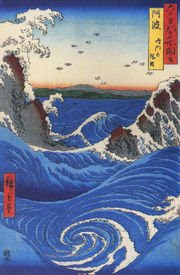
Before dinner, we took a boat ride at high tide into Naruto Strait to see the Naruto Whirlpools in action. The picture above is a famous Hiroshige woodblock print of these whirlpools. The eddies are caused by a combination of tidal currents and the meeting of the Pacific Ocean with the Inland Sea at the straits. March and April are the best time of year to see this phenomenon as the spring tides can cause the whirlpools to spin up to 20km/hr. It was really neat to see!
Also, I was struck by the quiet. Both Shikoku Island and Awaji Island (especially the tiny Ibi Port) were quiet, relaxing escapes. It's rare in today's world to find places where you can be totally relaxed and able to enjoy nature alongside the silence of your own thoughts. It's nice.
The next day, at another tidal extreme, we were able to see the whirlpools from 45 meters above the sea at the Uzu no michi, an observation deck under O-Naruto bridge.
After enjoying the whirlpools, the Eddy and Bridge Museum in Naruto and some delicious free samples of wakame seaweed, we adventured towards Tokushima City on Shikoku. (Woo! Another island of Japan checked off the list.)
We rode the Bizan Ropeway (basically a cable car) up Mt. Bizan and got a beautiful view of Tokushima with Awaji Island in the background. On a clearer day, you can also see the Kii Peninsula to the east. Tokushima was a cool city - it had palm trees, tall buildings and an unexpectedly large number of Italian restaurants. All around there were signs, posters, statues, etc.. having to do with the Awa Odori Festival. It looks like fun! If we are still here on the right dates in August when it occurs, we should definitely check it out.
Friday, March 14, 2008
Plum Blossoms are in Bloom!
 On February 25th, Kitano Tenmangu Shrine held its annual Baika-sai Plum Blossom Viewing. This festival is a "Nodate" or outdoor tea ceremony hosted by geiko and maiko beneath the beautiful plum blossoms at the shrine.
 Because of my Japanese class and tutoring schedule, I missed the actual tea ceremony, but I was still able to enter Sugawara Michizane's plum orchard, enjoy some plum blossom sweets and admire the blooms on my own. They say there are about 2000 plum trees in the orchard with most of the blossoms being either pink or white. It was beautiful and very peaceful.
Perhaps you were wondering... Who is Sugawara Michizane? Well, he was a scholar and politician from the Heian-era (9th c.) who is sort of the patron saint of Kitano Tenmangu shrine. In fact, his nickname "Tenjin-san" is the also the name of the monthly flea-market held on the shrine grounds. The Baika-sai festival has evolved from a prayer ceremony held at his death to ask for repose for his soul. It is said that he was crazy about plum (ume) trees!
I can understand his enthusiasm because the plum is associated with the start of spring, being among the first flowers to bloom. For Kyoto residents, the arrival of spring should mean finally being able to turn off our wimpy space heaters (glorified toasters) and to stop wearing fleeces and/or coats inside. I can only assume that winter felt even colder in the 9th c. since heaters and the like were not around. It's no wonder Tenjin-san loved this harbinger of warmer days.

All together now... Welcome Plum Blossoms! Welcome Spring!
Subscribe to:
Posts (Atom)
